Do You Plug Monitor into GPU or Motherboard? (2026 Complete Guide)
Last updated: July 19, 2026 | Estimated reading time: 14 minutes
If you just built a new PC or are setting up a fresh workstation in 2026, one of the most common questions you might have is where to plug in your monitor. Do you connect it to the graphics card or the motherboard? This seemingly simple question has caused confusion for decades, and the answer depends entirely on what kind of computer you have and what components are inside it. Plugging your monitor into the wrong port can result in poor performance, no display at all, or missing out on the full power of your dedicated GPU. In this guide, we’ll walk you through exactly where to plug in your monitor, when each option works, and how to avoid the most common mistakes people make when connecting displays to their PCs.
Short Answer: Plug It Into Your Graphics Card
The short answer is: if you have a dedicated graphics card installed in your PC, always plug your monitor into the graphics card, not the motherboard. The graphics card is the component responsible for rendering images, video, and 3D graphics. When you connect your monitor to the GPU, you get the full performance of that card, including higher frame rates, smoother visuals, and support for features like G-Sync, FreeSync, and high refresh rates.
If you plug your monitor into the motherboard instead, you will be using the integrated graphics processor built into your CPU. While this technically works for basic tasks like web browsing and word processing, you will not get any of the performance benefits of your dedicated graphics card. In many cases, your PC may not output video from the motherboard at all if a dedicated GPU is detected, leaving you with a blank screen and a lot of confusion.
The motherboard video outputs only work when your CPU has integrated graphics and there is no dedicated GPU installed, or when the BIOS is configured to prioritize the integrated GPU. In 2026, with most gaming and productivity builds including a dedicated GPU, the graphics card is almost always the correct choice.
When to Use GPU vs Motherboard Ports
Understanding when to use each set of ports depends on your hardware configuration. Here is a detailed comparison to help you decide:
| Scenario | Use GPU Ports | Use Motherboard Ports | Recommendation |
|---|---|---|---|
| Gaming PC with dedicated GPU | Yes | No | Always use GPU |
| Office PC without dedicated GPU | N/A | Yes | Use motherboard |
| PC with both integrated and dedicated GPU | Yes | Sometimes | Use GPU for display |
| Troubleshooting no display | Try first | Try second | Test both ports |
| Multi-monitor setup | All monitors | Avoid | Use GPU for all |
| Running a headless server | Depends | Depends | Usually neither |
The key takeaway is simple: if you have a dedicated graphics card, it should always be your primary display output. The only time you would use motherboard video outputs is when your CPU has integrated graphics and you do not have a separate graphics card installed in the system.
Integrated vs Discrete Graphics Explained
To understand why this matters, you need to know the difference between integrated and discrete graphics. These are the two types of graphics processors that exist in modern computers, and they have very different capabilities.
Integrated Graphics (iGPU)
Integrated graphics are built directly into the CPU chip. Intel calls this Intel UHD Graphics or Intel Iris Xe, while AMD refers to it as Radeon Graphics or AMD APU graphics. These processors share system memory (RAM) with the CPU and are designed for basic tasks like web browsing, document editing, video playback, and light gaming.
The advantage of integrated graphics is that they cost nothing extra since they are part of the CPU. They also consume less power and generate less heat. However, they are significantly slower than dedicated graphics cards and cannot handle demanding tasks like modern gaming, video editing, or 3D rendering effectively.
When you plug your monitor into the motherboard, you are using the integrated graphics. This means your expensive dedicated GPU sits idle doing nothing while the much weaker integrated processor handles all your display output.
Discrete Graphics (dGPU)
Discrete graphics cards, also known as dedicated GPUs, are separate components that install into a PCIe slot on your motherboard. Examples include the NVIDIA GeForce RTX 5000 series, AMD Radeon RX 9000 series, and Intel Arc B-series cards available in 2026. These cards have their own dedicated video memory (VRAM), their own cooling solution, and vastly superior processing power compared to integrated graphics.
A dedicated GPU can render complex 3D scenes, run games at high frame rates, accelerate video encoding and decoding, and drive multiple high-resolution monitors simultaneously. If you purchased a dedicated graphics card, you absolutely should be using it for your display output.
Understanding the difference between these two graphics solutions is essential. For a deeper look at how GPU performance varies across resolutions, check out our guide on how much VRAM you need for 1440p gaming, which explains why your GPU choice matters for different display configurations.
How to Check Which GPU You Have
If you are unsure whether your system has a dedicated graphics card or is running on integrated graphics, there are several easy ways to find out.
Method 1: Windows Task Manager
The quickest way to check is through Windows Task Manager. Press Ctrl + Shift + Esc to open Task Manager, then click on the Performance tab. Look for GPU in the left sidebar. If you see two GPU entries labeled GPU 0 and GPU 1, you have both integrated and dedicated graphics. GPU 0 is usually the integrated graphics, and GPU 1 is the dedicated card. If you only see one GPU entry, you either have only integrated graphics or only a dedicated card without integrated graphics enabled.
Method 2: Device Manager
Open Device Manager by right-clicking the Start button and selecting Device Manager. Expand the Display adapters section. Here you will see all graphics processors installed in your system. If you see both an Intel or AMD integrated graphics entry and a separate NVIDIA or AMD discrete GPU entry, you have both types available.
Method 3: Physically Inspect Your PC
The most foolproof method is to look at the back of your PC. If you see video output ports (HDMI, DisplayPort, or VGA) on the horizontal expansion slots near the bottom of the case, those belong to your dedicated graphics card. If you see video ports on the upper portion of the rear panel near the USB ports, those belong to the motherboard’s integrated graphics. When both sets of ports exist, always use the ones on the dedicated GPU for the best performance.
Method 4: DirectX Diagnostic Tool
Press Windows + R, type dxdiag, and press Enter. Click on the Display tab to see detailed information about your graphics hardware. This tool shows the exact model name, manufacturer, VRAM amount, and driver version for your primary display adapter.
Common Mistakes to Avoid
Even experienced builders occasionally make mistakes when connecting monitors. Here are the most common errors and how to avoid them.
Mistake 1: Plugging into the Motherboard with a GPU Installed
This is the single most common mistake. People build or buy a PC with a powerful dedicated GPU, then plug their monitor into the motherboard by accident. The result is a working display but terrible performance. Your games will run at a fraction of the frame rate they should, and your expensive GPU will sit completely unused. Always check the back of your PC and connect to the GPU’s ports.
Mistake 2: Plugging into the GPU Without Integrated Graphics
Some CPUs, particularly AMD Ryzen processors without the G suffix, do not have integrated graphics at all. If you plug your monitor into the motherboard with one of these processors, you will get no display output whatsoever. The screen will remain black and you might think your PC is broken. Make sure your CPU has integrated graphics if you plan to use motherboard video outputs.
Mistake 3: Using the Wrong Cable for Your Resolution
Not all cables support all resolutions and refresh rates. An older HDMI cable might not support 4K at 60Hz, and a DisplayPort 1.2 cable cannot handle 8K at full refresh rates. Make sure you are using a cable that is rated for the resolution and refresh rate you want to achieve. In 2026, DisplayPort 2.1 and HDMI 2.1 are the recommended standards for high-resolution, high-refresh-rate displays.
Mistake 4: Not Installing GPU Drivers
Even when your monitor is plugged into the correct port, you need to install the proper graphics drivers for your GPU to function at full capacity. Without drivers, Windows will use a basic display adapter that cannot take advantage of your GPU’s features. Always download the latest drivers from NVIDIA, AMD, or Intel’s official website after building your PC.
Mistake 5: Assuming More Ports Means More Performance
Some people think that using multiple ports on different devices will somehow boost performance. This is not true. Your monitor should always be connected to a single source, and that source should be your dedicated GPU when one is available.
Myths About Monitor Connections
Several myths persist about where to connect your monitor. Let us debunk the most common ones.
Myth: Motherboard Ports Are Better for Productivity
Some people believe that using the motherboard ports is better for productivity tasks like spreadsheets and word processing. This is false. Your dedicated GPU handles these tasks effortlessly and will actually provide a smoother desktop experience, better multi-monitor support, and more reliable performance than integrated graphics.
Myth: Using Both GPU and Motherboard Ports Gives You More Power
Connecting monitors to both your GPU and motherboard simultaneously does not combine their power. Instead, it creates an awkward hybrid setup where different monitors run on different graphics processors, which can cause compatibility issues, inconsistent performance, and problems with dragging windows between screens.
Myth: The GPU Port Matters Less Than the Cable Quality
While cable quality matters, the port you choose matters more. A premium HDMI cable plugged into the motherboard will still give you integrated graphics performance. The connection point determines which GPU processes your graphics, and that has a far greater impact on performance than cable quality alone.
For more information about how monitor settings affect performance, our article on whether lower resolution increases FPS covers how display configuration impacts your gaming experience.
Myth: You Can Break Your Monitor by Using the Wrong Port
This myth scares people into avoiding certain ports, but it is not true. You cannot damage your monitor by connecting it to the motherboard or GPU. The worst that can happen is that you get no display output or reduced performance. Monitors are designed to work with any standard video signal they receive.
Frequently Asked Questions
1. What happens if I plug my monitor into the motherboard with a GPU installed?
If your CPU has integrated graphics, the monitor will work but you will only get integrated graphics performance. Your dedicated GPU will not be used. If your CPU lacks integrated graphics, you will get no display at all.
2. Can I use both the GPU and motherboard video outputs at the same time?
In some cases, yes, but it is not recommended. Your system may allow you to connect monitors to both, but the monitors connected to the motherboard will use the weaker integrated graphics. This creates an inconsistent experience and is usually not worth doing.
3. How do I know which port on the back of my PC belongs to the GPU?
GPU ports are located on the horizontal expansion slots at the back of the case, typically lower down. Motherboard ports are on the upper I/O panel near the USB and audio ports. GPU ports are usually arranged horizontally, while motherboard ports are positioned vertically in the I/O shield area.
4. Does it matter which HDMI or DisplayPort I use on my graphics card?
For most users, all ports on a modern GPU provide identical performance. However, some GPUs have different port versions, and using DisplayPort is generally recommended over HDMI for high-refresh-rate gaming because DisplayPort typically supports higher bandwidth.
5. Why is my monitor showing no signal even when plugged into the GPU?
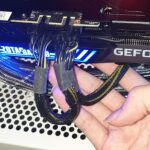
Several things could cause this: the GPU might not be properly seated in the PCIe slot, the GPU power cables might not be connected, the monitor might be set to the wrong input, or the GPU drivers might not be installed. Try reseating the GPU and checking all connections.
6. Can I plug a 4K monitor into my motherboard?
It depends on whether your CPU’s integrated graphics supports 4K output. Modern Intel and AMD processors with integrated graphics can typically drive a 4K display at 60Hz, but the performance will be limited compared to using a dedicated GPU.
7. Does this advice change for laptops?
Laptops are different because they have built-in displays connected to whichever GPU the manufacturer chose. External monitor ports on laptops are typically wired to the discrete GPU when one is present, so you generally do not need to worry about this choice on a laptop.
8. Should I disable integrated graphics in BIOS after installing a GPU?
It is generally not necessary, but you can if you want to. Keeping integrated graphics enabled can be useful for troubleshooting. Some users prefer to disable it to ensure Windows always uses the dedicated GPU, but in most cases the system handles this automatically.
9. Will using the motherboard port damage my graphics card?
No. Using the motherboard video output will not damage your graphics card. The GPU will simply sit idle while the integrated graphics handles the display output. There is no risk of hardware damage from using the wrong port.
10. What if my PC only has motherboard video outputs?
If your PC case only shows video ports on the motherboard I/O panel and none on the expansion slots, it means either your PC does not have a dedicated graphics card, or the card is not properly installed. Check inside the case to verify the GPU is seated in the PCIe slot.
Conclusion
The answer to whether you should plug your monitor into the graphics card or motherboard is straightforward: if you have a dedicated GPU, always use it. The graphics card is designed specifically for display output and provides vastly superior performance compared to the integrated graphics on your motherboard. Plugging into the wrong port is one of the most common mistakes in PC building, but it is also one of the easiest to fix.
By checking which GPU your system has, understanding the difference between integrated and discrete graphics, and connecting your monitor to the correct port, you can ensure you are getting the full performance you paid for. If you are troubleshooting display issues, try both sets of ports to isolate the problem, but in normal use, your dedicated GPU is always the right choice for your primary display connection.
For more guides on optimizing your PC setup, explore our articles on whether G-Sync affects FPS and other hardware topics to get the most out of your system in 2026.